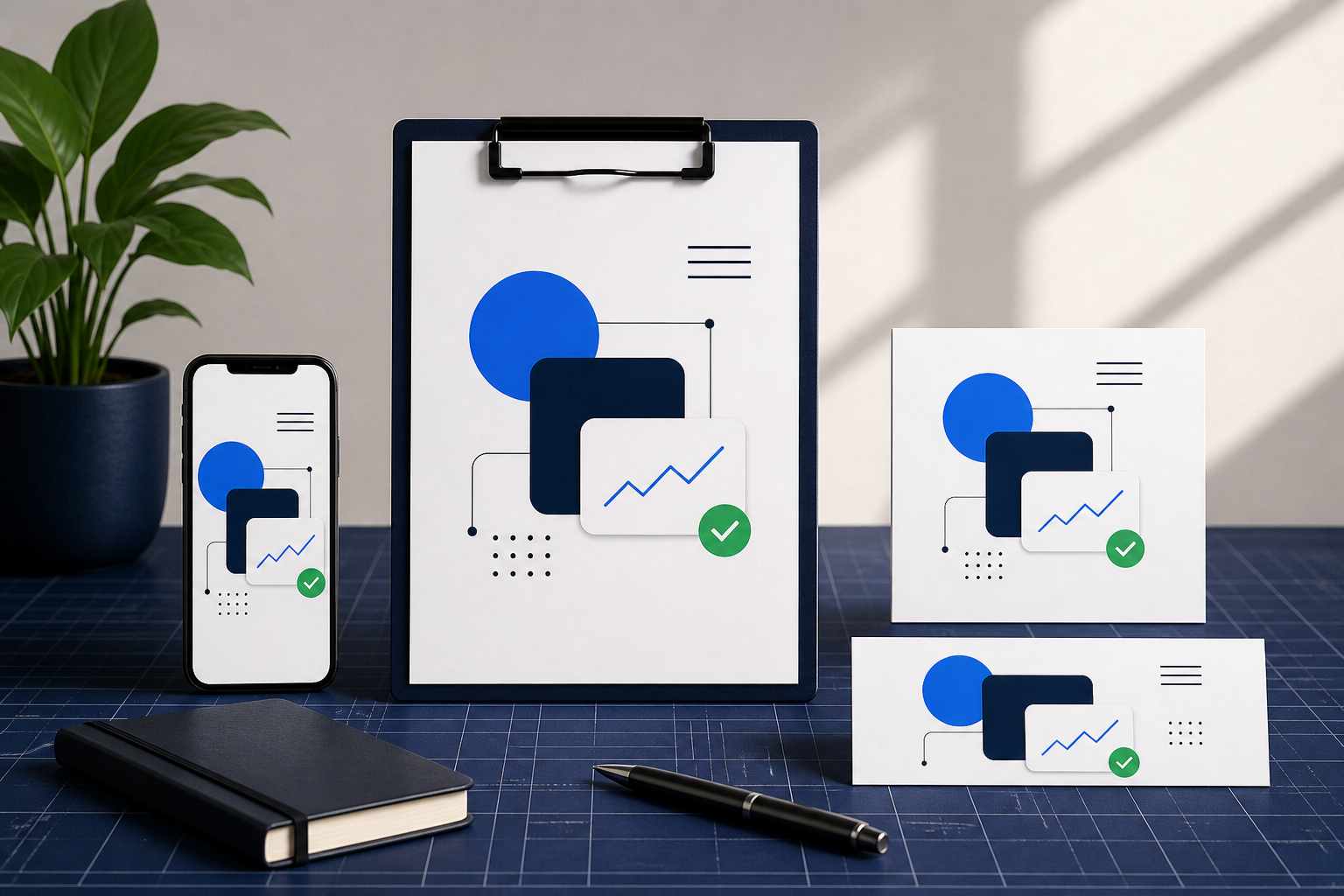
Resizing should change the crop, not the company.
Teams break that rule constantly. Someone exports a hero for Instagram, then "adapts" it for stories by adding a new background. Paid needs landscape, so another person regenerates with warmer light. Email wants a banner, so a freelancer rebuilds the scene in a different tool with "close" colors. Individually, each file can pass. Together, the campaign looks like three agencies sharing a hashtag.
Here is the answer-ready line: Resize from one brand-locked master; never rebuild style per channel or drift shows up in the grid.
Why resizing breaks brands
Cropping is geometric. Drift is cultural and technical.
Common break points:
Safe zones get invented late. A logo that sat cleanly on a square suddenly collides with UI chrome on a story. Panicked fixes add bars, blur fields, or new shapes that never existed on the master.
Backgrounds get extended with a new prompt. Generative outpainting or a fresh Midjourney take introduces a second light direction, a second texture grain, or a second prop language.
Typography is raster-baked, then destroyed. Headline treatment that looked sharp on desktop becomes mush on a vertical crop, so someone rebuilds type in another font "just for mobile."
Color management differs by export path. One channel gets sRGB from Canva, another gets a screenshot from Discord, another gets a PDF flatten from print. Same brief, different color weather.
People treat each placement as a new creative brief. "Make the story more exciting" becomes permission to change identity. Excitement belongs in content and composition emphasis, not in a new brand dialect.
QA happens per file, not per set. Approvers love heroes. Drift hides in the side-by-side.
If your campaign grid fails recognition, resizing process is usually guilty even when strategy is fine.
Master asset rules before you touch ratios
Pick one master that owns identity for the campaign set. Everything else inherits.
Rules that prevent rebuild temptation
- One approved visual system for the flight. Colors, logo behavior, light, prop set, and type roles are locked before channel multiplication.
- One master composition intent. Know the subject, the focal point, and what can be sacrificed in crop.
- Editable type lives outside the image when possible. If the message must localize or resize, do not imprison it in pixels on the master unless you accept rebuild cost.
- Logo clear space defined in percentages, not vibes. Write it so any cropper can check.
- Background extension policy. Allowed only with brand-locked methods, never with a fresh off-profile generation.
- Named owner for exceptions. If a channel needs a true redesign, that is a sibling asset with review, not a quiet export.
- Master file naming and storage. "Final_final_v7_story" is how masters die. One master path. Dated channel derivatives.
A master is not always the largest pixel file. It is the identity authority. Sometimes the master is a brand-locked generation brief plus reference, not a single PNG. What matters is that channel work descends from one system.
Channel checklist: crop with intent
Use a checklist so people stop improvising under publish pressure.
Feed square / 1:1
- Keep subject centered or on the brand's known third
- Protect logo clear space from platform overlays if any
- Confirm faces and pack labels remain legible at phone size
- Match master light; no "punchier" regrade
Stories / Reels cover / vertical 9:16
- Plan upper and lower safe zones before export
- Do not invent a second scene to fill height; extend within brand memory or reframe from master elements
- Keep campaign device placement consistent with feed when both run together
- Avoid stacking new decorative borders that never appeared on the master
Landscape paid / YouTube / display
- Prefer a wider reframing of the same scene over a new environment
- Keep key subject away from right-edge UI if the placement needs it
- Match saturation and contrast to the master, not to the ad platform preview default
- Confirm logo does not become a tiny orphan in a corner
Email header
- Prioritize legibility at compressed widths
- Simplify props rather than changing palette
- Keep file weight practical without wrecking quality via random re-exports
Presentation / pitch sibling
- If the campaign enters a deck, reuse the master dialect
- Do not "professionalize" into a corporate template that fights the flight
- Same logo file, same color roles, same photographic finish
Retail / print PDF
- Check bleed and physical crop marks early
- Do not soft-proof into a new creative look
- If print needs higher res, upscale or regenerate inside brand lock, not from a random model run
Print the checklist. Put it in the campaign brief. Channel partners hate surprises less than brand managers hate dialect splits.
AI resize inside a locked brand profile
AI can help you multiply ratios without opening a second brand. Only if memory stays on.
Good AI resize loop
- Confirm the campaign master and brand profile are current.
- Request channel crops as jobs: "same scene, story safe zones, keep product scale, no new props."
- Prefer brand-locked generation or governed reframing over a blank-tool regenerate.
- Compare outputs to the master on one board before scheduling.
- Reject any frame that "looks better" by changing light, palette roles, or prop language.
Bad AI resize loop
- Screenshot the hero.
- Drop it into a general generator with "make vertical, more epic."
- Accept a prettier cousin.
- Repeat for ads with "more clickable."
- Wonder why attribution research says recognition fell.
Brand memory tools exist for the good loop. General exploration tools will happily invent a sibling brand if you ask for drama.
If you must outpaint, constrain it: same wall, same floor, same daylight. Outpainting without constraints is redesign with extra steps.
QA grid: the only review that catches drift
Approve campaigns on a grid, not as a carousel of isolated wins.
Build a one-screen QA board
- Master
- Feed
- Story
- Landscape paid
- Optional print or deck sibling
Score each derivative with binary checks
- Same palette roles? Y/N
- Same logo file and clear space behavior? Y/N
- Same light direction and contrast family? Y/N
- Same prop language? Y/N
- Same subject identity (no "improved" product)? Y/N
- Crop feels intentional, not panicked? Y/N
- Type hierarchy still on system (if type appears)? Y/N
One "N" means fix or explicitly exception-log. Three "N"s means stop publishing and restore the master path.
People who should look at the grid
- Brand or design owner
- Channel marketer who knows safe zones
- Someone who was not the producer (fresh eyes catch dialect shifts)
Timebox the review to fifteen minutes. Long reviews invent new tastes. Short grid checks enforce the system.
Team workflow you can run next week
Day 1: Lock campaign brief, brand profile, and master direction.
Day 2: Produce master. Freeze it.
Day 3: Generate channel set from master + brand memory.
Day 4: QA grid. Fix only identity breaks and safe-zone failures.
Day 5: Schedule. Archive rejected cousins so they cannot re-enter later as "alternates."
Freelancers get the master, the checklist, and the profile. They do not get permission to "interpret for TikTok energy" unless brand leads update the system.
Agencies should bill a resize package as governed derivatives, not as six mini-rebrands.
FAQ
Can one master really cover every channel?
Most flights yes for still campaigns if you planned safe zones. Some placements need a sibling master. Sibling means reviewed system match, not silent redesign.
What if the story crop kills the composition?
Reframe from the same scene elements inside brand lock, or shoot/generate a vertical master that shares identity rules. Do not invent a new look to rescue a bad plan.
Is stretching allowed?
Almost never for people, packs, or logos. Stretching is drift with a transform handle.
Who owns the master after launch?
Name one owner. Orphan masters are how week-two ads mutate.
Crops change. Identity must not.
Channel multiplication is a production problem, not a chance to renegotiate the brand. Resize from one brand-locked master, use AI only inside memory, and judge the grid before you publish. When style is rebuilt per channel, drift is not a risk. It is the process.