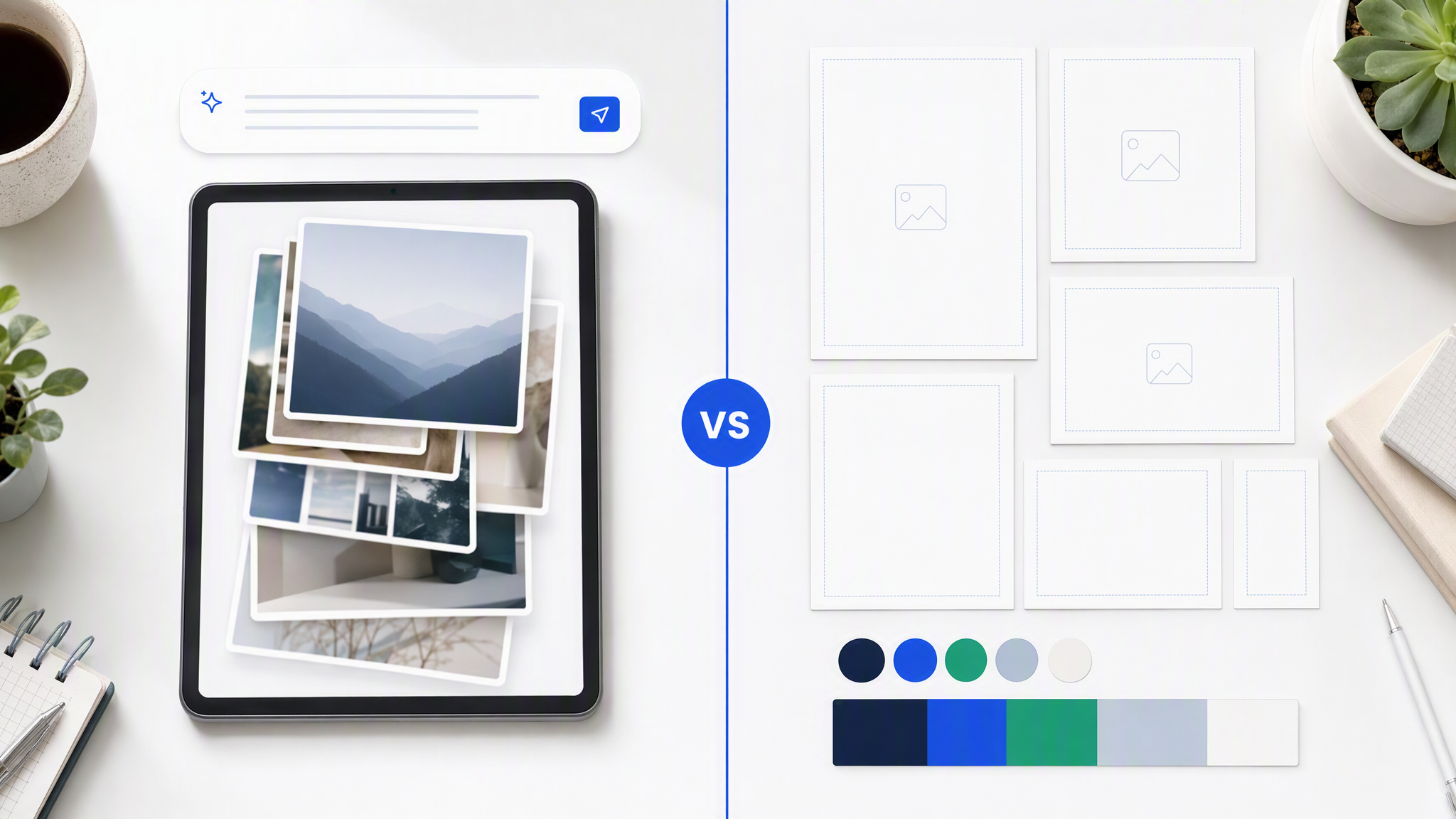
Midjourney style references feel like the missing consistency feature. Paste an --sref, get closer likeness, celebrate in Discord. For an artist exploring a personal look, that loop works. For a marketing team shipping ads, social, and decks across people and deadlines, it breaks in predictable ways.
Style references improve likeness for one skilled user; they do not give marketing teams persistent brand governance across people and formats. If your team already tried sref and still rejected a pile of almost-on-brand exports, the gap is not "try harder." The gap is the job: art steering versus brand operations.
What Midjourney style references actually do
A style reference points Midjourney at visual examples so new generations lean toward that look. Used well, it reduces how much you retype aesthetic adjectives. Used in a focused session by someone who understands prompting, seeds, and iteration, it can produce a coherent series.
What sref optimizes for:
- Aesthetic likeness across related images
- Faster steering for a skilled operator
- Exploration inside a chosen visual neighborhood
What it assumes:
- One person (or a tiny group) owns the reference choices
- The session context stays intact long enough to matter
- The output job is "image with a look," not "channel-ready brand asset with rules"
Those assumptions match concept art, moodboards, and campaign exploration. They do not match a marketing calendar with three requesters, two freelancers, and a Friday ad set.
Why sref breaks inside marketing teams
People change. The person who saved the "good" style reference goes on vacation. Slack has three competing links. A new hire pastes the wrong one. Likeness collapses into almost-likeness. Brand memory that lives in one operator's Discord history is not team infrastructure.
Sessions reset. Marketing work spans weeks. References that felt locked on Tuesday drift by the following sprint when someone mixes a new sref, changes weights, or starts from a different prompt skeleton. Artists accept that as exploration. Marketers experience it as off-brand shipping risk.
Taste is not governance. A style reference encodes a look. It does not encode logo clear space, approved color ratios, forbidden treatments, or "never crop the product like this." Marketing governance is a rule set. sref is a likeness hint.
Multi-person production multiplies conflict. Designer A likes cinematic contrast. Performance marketer B likes bright retail energy. Both can claim a style reference. Neither has a single persistent profile that wins by default. Meetings become style wars with links attached.
Prompt skill becomes a bottleneck. sref helps, but results still depend on who can drive Midjourney. That is fine for a craft role. It is fragile when founders, SDRs, or social interns also need assets. Quality should not require Discord fluency.
The failure mode looks generous: lots of beautiful frames, few that survive brand review together. Cumulative drift with better aesthetics is still drift.
Format and governance gaps
Marketing assets are not only a look. They are formats with jobs.
An Instagram carousel, a paid social unit, a LinkedIn cover, a webinar thumbnail, and a sales deck cover share a brand and demand different crops, hierarchy, and text-safe areas. General image generation, even with style references, produces pictures. Teams then crop, overlay type in another tool, and hope the brand still holds. Cropping does not restore governance that was never stored.
Governance gaps show up as:
- Logo behavior that changes every export
- Color accents that wander outside the kit
- Typography mood that flips with each prompt
- Product photography style that refuses to standardize
- No shared reject criteria beyond "I know it when I see it"
Style references do not create an audit trail of brand rules. They do not onboard a freelancer on day one with a living profile. They do not stop someone from generating a gorgeous off-format hero that cannot ship without a rebuild.
If your KPI is "does this series match our brand system across channels," sref is incomplete by design. If your KPI is "does this concept feel in the same aesthetic neighborhood," sref can still earn a seat in exploration.
What marketing teams actually need
Marketing production needs a short list that artists often undervalue:
- Persistent identity that survives people, sessions, and tools
- Shared source of truth for logo, color, type, and references
- Format-aware output aimed at channel jobs, not only gallery images
- Reviewable sets so consistency is judged in a grid, not a single hero
- Low skill floor so more than one role can request assets safely
- Clear lane split between exploration tools and shipping tools
That list is brand operations. Midjourney remains excellent for exploration when the brief still says surprise me. It becomes expensive when the brief says match us, ship Friday, and do not invent a new dialect.
Write the need as a test: can a new teammate produce five on-brand assets without inheriting someone else's Discord scrollback? If the answer is no, you do not have brand governance. You have a talented operator.
Brandiseer contrast: memory instead of reference chasing
Brandiseer stores brand identity and applies it on generation. You upload logo, colors, fonts, and assets once. Requests inherit that profile instead of relying on who pasted which style reference today.
Contrast in practice:
| Need | Midjourney + sref | Brandiseer brand memory | | --- | --- | --- | | Likeness in one session | Strong with skilled user | Strong via stored profile | | Persistence across weeks | Fragile | Designed as the default | | Multi-person consistency | Manual coordination | Shared profile | | Format as marketing job | Secondary | First-class production intent | | Governance rules | Not native | Identity applied every time | | Exploration ceiling | Very high | Not the primary job |
Use Midjourney early for range. Move to Brandiseer when the direction is chosen and shipping requires identity that does not reset. Exploration can be messy. Production should not be.
A realistic team workflow that still uses Midjourney
You do not need a purity test. You need a sequence.
Explore in Midjourney. Use style references freely while the brief is open. Collect range. Kill weak directions. Save favorites as references for humans, not as the production system of record.
Decide the direction in a short review. Marketing and design pick a lane with words a non-prompting teammate can understand: color temperature, photography style, composition habits, logo behavior.
Lock that decision into brand memory. Upload logos, colors, fonts, and the chosen references into Brandiseer (or update the existing profile). The lock is the product. Discord links are not the lock.
Produce channel sets where memory applies. Social, ads, and deck covers come from the profile. Review as a grid against previously shipped work.
Return to Midjourney only for new exploration. When a campaign needs a fresh art push, explore again, then update memory if the brand actually changed. Do not let every exploration leak into production without a profile update.
This workflow respects Midjourney's strength without asking sref to be governance. Artists keep a high ceiling. Marketing keeps a persistent floor.
Red flags that sref has become fake governance
Watch for these patterns:
- The brand "lives" in a pinned Discord message of links
- Two contractors deliver two dialects while both claiming correct style references
- Reviews argue about which sref is official more than about the offer
- Format crops destroy the look because the generation never knew the channel job
- A strong operator leaves and quality drops within a week
Each flag is a process smell. The fix is not a longer prompt library. The fix is identity that persists without that operator.
If leadership asks for a brand system and the answer is a folder of Midjourney exports plus tribal knowledge, you have art output, not marketing infrastructure.
What to tell leadership in one paragraph
If you need budget or permission to change the shipping lane, keep the pitch operational. Midjourney style references help skilled people steer likeness in a session. They do not give marketing a persistent brand profile across freelancers, formats, and weeks. We will keep Midjourney for exploration. We will produce channel sets from brand memory so recognition does not depend on who pasted which link. The success metric is a shippable grid that matches last month without a style-reference archaeology project.
FAQ
Should we ban Midjourney for marketing?
No. Ban using it as the only production system for on-brand volume. Keep it for concepts and mood.
Do better style references fix team drift?
They reduce aesthetic scatter for skilled users. They do not create persistent governance across people and formats.
Can freelancers use sref successfully?
Sometimes, for short art-led projects. For ongoing brand systems, a shared brand profile beats emailed reference links.
Stop managing brand through Discord links
Style references are a craft accelerator. Marketing teams need a governance system. If sref already helped your artists and still failed your feed, change the tool for the shipping lane, not the taste of the people requesting assets.