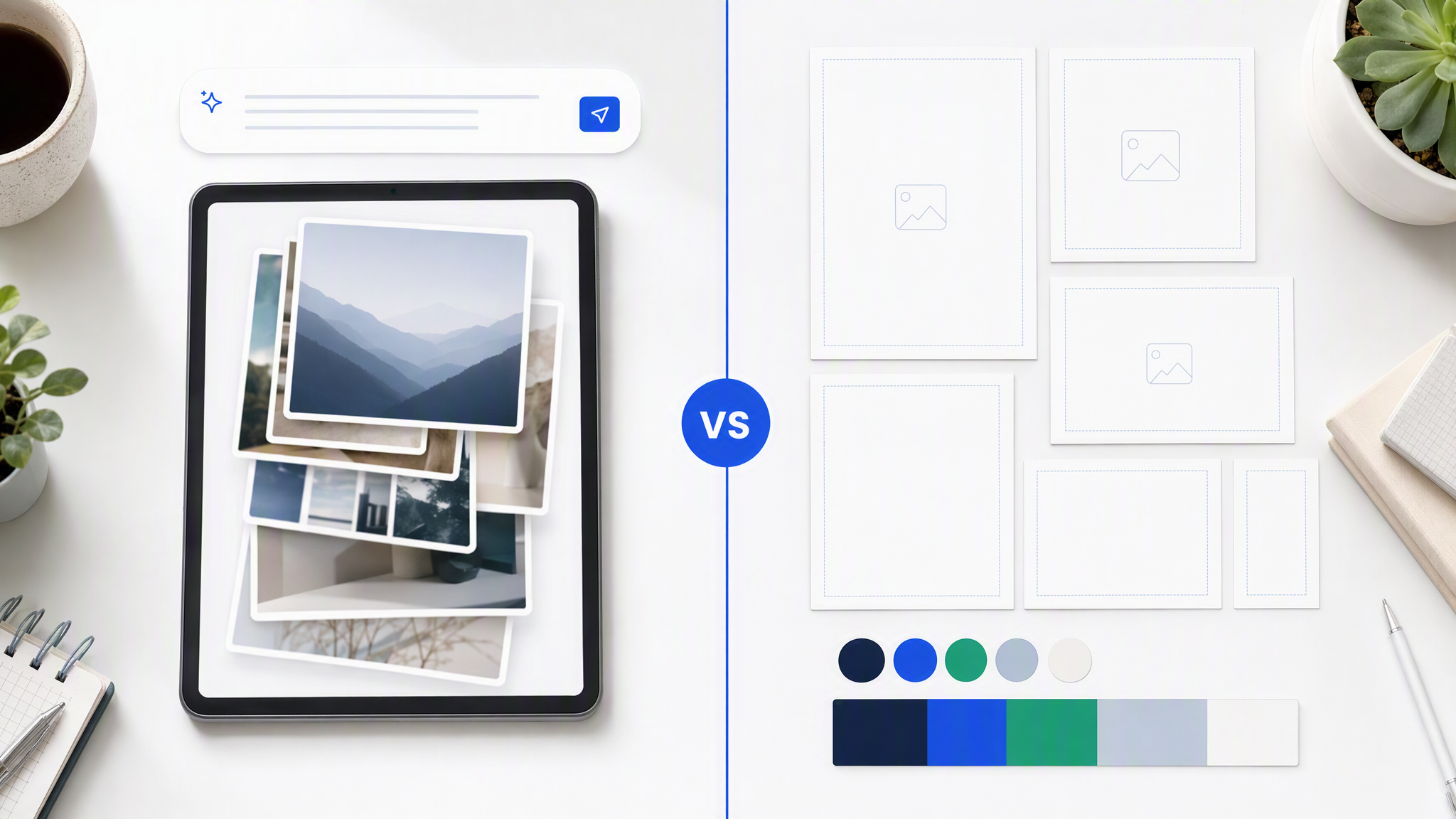
You tried ChatGPT for copy. You tried Midjourney for visuals. The files looked sharp in isolation. Then you lined up last month’s posts, ads, and deck covers and the brand fell apart. Cool one week. Loud the next. Logo placement wandered. Colors almost matched. Fonts argued with each other. Pretty, mismatched assets are the default outcome when every tool starts from zero.
Brand memory is a persistent machine-readable brand profile applied on every generation so teams stop re-describing identity in each prompt. That is the whole idea. Not a longer prompt. Not a PDF nobody opens. A stored identity layer the system actually uses.
Storing your look is not a longer prompt
A prompt is a request. Brand memory is the context that should already be true before the request starts.
When you paste “use navy #0B1F3A, Inter for headlines, keep logo clear space, quiet premium mood” into every Midjourney or ChatGPT box, you are doing unpaid system work by hand. You are also hoping the model weights those instructions the same way tomorrow, in another chat, with another teammate, on another format. That hope is not a system.
Brand memory flips the order. Identity is stored once as structured data: logo behavior, palette roles, type stack, visual personality, and the constraints that make “us” recognizable. The generation request then describes the job (summer sale Instagram square, webinar LinkedIn cover, product launch banner), not the company. The profile rides along automatically.
That distinction matters for AI design teams because production volume exposes prompt fragility. One good prompt can make one good asset. Ten good prompts across three people and four tools make ten dialects of almost-branded. Memory is what keeps the dialect shared.
If a tool resets to a blank aesthetic every session, it is prompt-only for brand purposes, even if it is powerful at art. Capability without persistence still drifts.
Style guide vs memory
Most teams already have something they call a brand kit. A Notion page. A Figma library. A 40-page PDF with margins and “do not” examples. Those documents are useful for humans. They are not brand memory for machines.
| Artifact | Who uses it | What it does | Failure mode | | --- | --- | --- | --- | | Style guide / brand book | People | Explains rules in prose and examples | Gets ignored under deadline | | Template Brand Kit | People inside one editor | Locks colors/fonts while assembling layouts | Starts from someone else’s template | | Prompt library | Skilled operators | Replays adjectives and references | Breaks when people or tools change | | Brand memory | The generation system | Applies a living profile on every run | Only as good as what you stored |
A style guide answers “what should we look like?” Brand memory answers “what does the system enforce without us retyping it?”
You can have a perfect PDF and still ship off-brand AI work, because the PDF never enters the generation loop. Someone has to translate it into adjectives, hex codes, and “make it more premium” comments. Translation is lossy. Under Friday pressure, people skip it. The feed becomes a collage of almosts.
Canva Brand Kit sits closer to the work than a PDF, and it helps. It still assumes a human is assembling or correcting inside a template workflow. That is not the same as generative memory: original assets that inherit identity before the first pixel is chosen. Manual apply and automatic inheritance are different jobs. Confusing them is how teams buy another kit feature and keep rewriting prompts.
How drift compounds
Drift is not one wrong file. Drift is the cumulative effect of tools that do not share state.
Monday: Midjourney moodboard leans cool and minimal. Tuesday: a ChatGPT image pass goes warmer because the prompt mentioned “friendly.” Wednesday: Canva template #47 puts the logo in a corner your real system never uses. Thursday: a freelancer “matches the vibe” from memory of last week’s Slack screenshot. Friday: you approve five assets that each look fine and together look like a holding company.
Audience recognition is the cost. People learn brands the way they learn faces: repeated cues in the same ratios. When color dominance flips weekly, type mood changes by channel, and composition rules reset per tool, recognition tax rises. You spend more on media to get the same “oh, that’s them” effect.
Operational cost stacks too:
- Re-prompt tax. Every new chat reconstructs identity. Quality depends on who remembers the good phrase stack.
- Review tax. Designers and marketers spend cycles killing pretty options that break the system instead of improving on-brand ones.
- Onboarding tax. New freelancers and interns inherit a folder of examples and a PDF. They do not inherit a machine profile. Their first week becomes a drift accelerator.
- Channel tax. Cropping a square into a story does not restore rules that were never applied. Format changes amplify inconsistency when identity was never locked.
Prompt-only tools drift because they optimize the single output. Marketing needs the set. The set is where brand lives. If your workflow cannot guarantee that asset ten matches assets one through nine without a human holding the style guide open, you do not have memory. You have hope and screenshots.
What to store (so memory is real)
Brand memory only works if the profile is concrete. Vague mood words are not enough. Store the parts that survive format changes and teammate changes.
Logo. File variants (primary, mono, clear-space rules), minimum size, forbidden treatments, preferred placement zones for common formats. Without this, generators invent badge-like marks or crowd the mark into corners that break packing.
Palette. Not just hex codes. Roles: primary, secondary, accent, background, text, alert. Dominance rules (how much primary vs accent on a social square). Forbidden combinations. Contrast floors for small text. A list of colors without roles still lets models pick a neon accent because it “pops.”
Type. Families for display, body, and UI if relevant. Weight ranges you actually use. Hierarchy habits (how loud headlines get on ads vs LinkedIn). Fallback behavior when a channel cannot load the brand font. “Clean sans” is not a type system.
Visual personality. The enforceable preferences: photography vs illustration bias, lighting mood, cropping aggressiveness, whitespace tolerance, corner radius, line weight, icon style, texture (flat, grain, none). This is where two brands with the same navy and Inter still look different. Personality is not poetry. It is a checklist of allowed moves.
Examples and anti-examples. A few approved assets and a few “never again” files teach the profile better than adjectives. Memory should be able to point at evidence, not only at slogans.
Channel defaults (optional but useful). Preferred safe margins for stories, carousel title zones, ad CTA clearance. These are production constraints, not brand poetry, and they prevent “on-brand but unusable.”
If your kit stops at logo + three hexes, you can still start. Thin memory beats no memory. Expand the profile when reviews keep catching the same miss.
How Brandiseer applies your stored look
Brandiseer is built around that stored profile, not around a prompt lottery.
You upload logo, colors, fonts, and existing assets once. Brandiseer turns that into brand memory and applies it on every generation. You describe the job in plain language. The system generates against the profile you already defined. New teammates do not need a secret prompt doc to stay close. The shared source is the brand profile, not last week’s Slack thread.
That is the operational difference for marketers who already felt pretty-but-mismatched output:
- Upload once. Capture identity as data, not as a paragraph you paste forever.
- Request the asset. Channel and intent first. Style second, because style is already stored.
- Review the set. Judge five files together for recognition. Kill outliers against the profile, not against personal taste of the day.
- Iterate inside memory. Adjust the job or tighten the profile. Do not rebuild the company in adjectives for each retry.
Brandiseer does not claim to replace strategy, positioning, or flagship art direction. It claims the production lane should stop resetting identity between clicks. For AI design teams, that is the gap between exploration tools and shipping tools. Explore where surprise helps. Ship where memory holds.
Commercial details and credits live on the product site. Evaluate with your real kit and a real week of assets. The honest test is whether the next ten files look like one brand without re-teaching the system each time.
Checklist: do you have memory or just a PDF?
Use this as a ruthless audit. Answer yes or no.
- Does identity persist across sessions without pasting? If every new chat needs the brand paragraph again, you have prompts, not memory.
- Can a new teammate generate on-brand work on day one without the “good prompt” doc? If quality depends on tribal knowledge, memory is not shared.
- Is the kit machine-readable in the tool that generates? A PDF in Drive does not count unless the generator loads it as profile data.
- Do logo, palette roles, type, and visual personality all exist as constraints? Colors alone are not a brand profile.
- Do you review assets as a set for recognition? If you only approve heroes one by one, drift hides in the feed.
- Does changing tools reset the look? If Midjourney, ChatGPT, and Canva each invent a dialect, you have multi-tool drift, not a system.
- When someone is out sick, does the look leave with them? If yes, you stored skill in a person, not memory in the stack.
- Can you name what “off-brand” means in five concrete rules? If the only answer is “I’ll know it when I see it,” the system cannot enforce it.
- Do anti-examples exist? Forbidden moves prevent pretty mistakes faster than mood words.
- Is production volume making consistency worse, not better? Volume amplifies whatever system you have. Worse consistency at higher volume is the fingerprint of prompt-only workflows.
Score it simply. Mostly no: you have documentation and hope. Mostly yes: you have brand memory, or you are close enough to operationalize it.
Stop re-describing the company in every box
Prompt craft helped you get started. It will not hold a campaign calendar. Brand memory will, because it turns identity into a persistent layer instead of a weekly translation job.
If your drive is already full of sharp files that do not recognize each other, stop lengthening prompts. Store the profile. Generate from it. Review the grid.