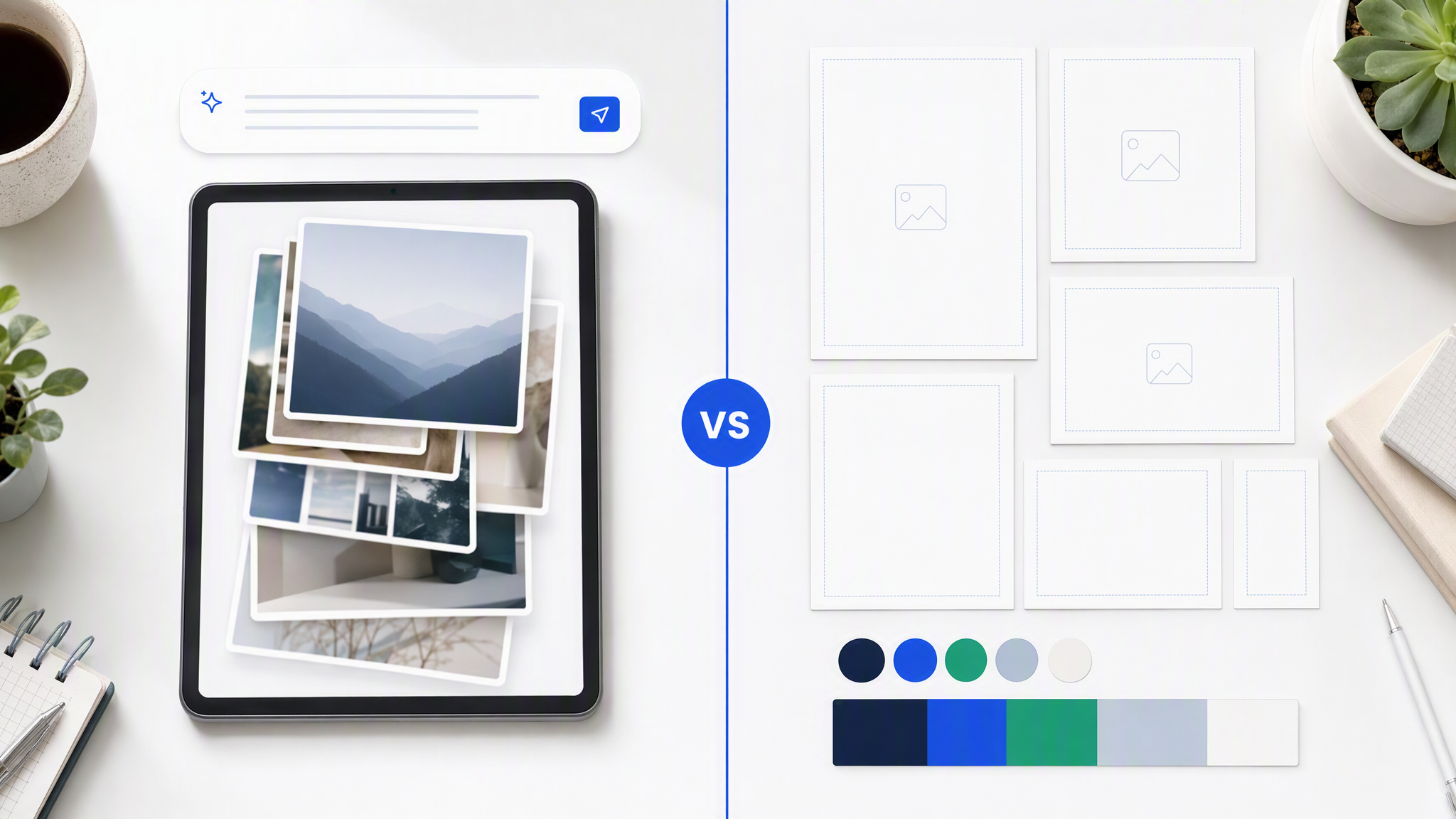
Brand kits sound like the same product everywhere: colors, fonts, logos, maybe templates. Under the hood they are not. Some kits are libraries you browse and apply. One class of tools treats identity as memory that drives generation automatically.
That difference decides how much consistency you get when the calendar fills up. Traditional brand kits store assets for manual use; generative brand memory applies identity on every generation without re-assembly. If you are comparing Canva, Adobe Express, and a brand-memory workflow, start there, not with feature checklists that pretend every "kit" does the same job.
What a brand kit is supposed to do
A brand kit exists to stop teammates inventing a new look every Tuesday.
At minimum it should hold:
- Logo files and usage rules
- Color values people can actually pick
- Fonts or type styles approved for marketing
- Optional templates, photos, or layout patterns
The kit fails when it becomes a PDF nobody opens, a folder of outdated exports, or a feature that only works if someone remembers to turn it on. Storage is not the same as application. Application is not the same as generation.
Manual kits shine when a human is assembling a layout and needs guardrails. Generative memory shines when the request is "make the next asset" and identity should already be loaded. Most teams need clarity on which problem they are solving this quarter: assembly with guardrails, or production with automatic inheritance.
Canva Brand Kit: strong library, manual apply
Canva Brand Kit is familiar for a reason. Teams load brand colors, fonts, and logos, then build inside templates. Non-designers get a path to "close enough" without opening professional design software. Collaboration, comments, and shared folders make that path practical for marketing ops that live in weekly social and light campaign work.
What Canva does well:
- Central colors and fonts that reduce neon accidents
- Logo access inside the editor
- Template browsing that gets a layout on screen fast
- Shared Brand Kit settings for teams on paid plans
What stays manual:
- Someone still picks a template family
- Someone still swaps photos, spacing, and hierarchy
- Consistency depends on people choosing the kit and resisting off-brand stock
- Originality is limited by how often competitors used the same layout family
Canva is a library-plus-editor model. The kit constrains the palette. The human still assembles the piece. That is powerful for one-offs and dense layouts that need drag-and-drop control. It is slower when your bottleneck is volume of original, on-brand assets that should not start as someone else's template.
Adobe Express: creative cloud adjacency, still assembly-led
Adobe Express sits closer to Adobe's wider creative world while aiming at faster, lighter production than full Photoshop or Illustrator workflows. Brand kits and libraries help teams keep logos, colors, and approved assets nearby. For organizations already in Adobe ecosystems, that adjacency matters: assets can travel with less friction between "quick social" and heavier design work.
Strengths to weigh:
- Brand kits and libraries for approved assets
- Templates and quick edits for social and light campaigns
- A bridge toward deeper Adobe tools when a piece needs serious craft
- Familiar controls for teams that already think in Adobe terms
Limits that show up in marketing ops:
- The starting point is still often a template or a blank you build
- Brand application remains a human step inside the editor
- Cross-person consistency still depends on process, not automatic inheritance on every generation
- High volume means repeated assembly decisions, even with a clean kit
Adobe Express is a strong assembly lane when your company already standardizes on Adobe and needs speed without abandoning that stack. It is not the same product as generative brand memory. You still apply the kit. The kit does not generate the next ten matching assets from a job description alone.
AI that remembers your look: identity applied automatically
Generative brand memory flips the order. You upload logo, colors, fonts, and reference assets into a persistent profile. When you request an Instagram post, a deck cover, or an ad unit, the system applies that identity without asking you to rebuild style in the prompt or browse for a template that almost fits.
Operational traits:
- One upload (or ongoing profile updates) instead of re-prompting style each asset
- Generation starts from identity, then fills the job
- Teammates inherit the same lock without a secret prompt doc
- Format-aware requests can map to marketing channel jobs, not just "make an image"
This model still needs review. It does not replace strategy, legal checks, or a designer for rebrands. What it removes is the reset cost: the empty box that knows nothing about you until you type a paragraph of adjectives.
Brandiseer is built around that memory model. Compare it to Canva or Adobe Express as different jobs, not as three skins on the same kit feature.
Side-by-side comparison
| Dimension | Canva Brand Kit | Adobe Express brand kits | Generative brand memory | | --- | --- | --- | --- | | Primary job | Template assembly with brand guardrails | Fast creative assembly in Adobe-adjacent workflows | Original assets that inherit stored identity | | How brand is used | Manual apply inside editor | Manual apply from libraries/kits | Automatic apply on generation | | Starting point | Template or blank canvas | Template, blank, or imported asset | Job description + brand profile | | Consistency driver | People remembering to use the kit | Process + libraries | Persistent profile | | Best volume pattern | Steady template customization | Quick edits and light campaigns | Recurring channel production | | Weak spot | Template sameness; human drift | Still assembly-led at scale | Needs clear kit; not for open art exploration | | Who feels the win | Teams editing layouts by hand | Adobe-standardized orgs | Founders and marketers shipping many on-brand assets |
Read the table as job matching, not as a scoreboard. A tool can win its lane and still be wrong for your bottleneck.
Who should pick what
Pick Canva Brand Kit when your work is template-led, teammates need drag-and-drop control, and the main failure mode is people inventing colors. Social one-offs, event graphics with unusual structure, and collaborative layout edits fit. Accept that originality and sameness will trade off with template families.
Pick Adobe Express when the company already lives near Adobe tools, assets must move between quick marketing pieces and deeper design work, and brand libraries are part of a wider creative standard. Use it as the fast assembly layer, not as a substitute for persistent generative memory.
Pick generative brand memory (Brandiseer) when the calendar demands original marketing assets that must look like one brand across people and formats. Founders without a designer, marketers tired of re-teaching style, and teams drowning in almost-on-brand AI exports are the clearest fit. Upload once. Generate from the profile. Review the set.
Use more than one when jobs mix. Explore art elsewhere. Assemble rare layouts in Canva or Express. Ship recurring branded volume where memory persists. Write that lane map into the team wiki once so every campaign does not restart the tool debate.
Migration notes without a rip-and-replace
Most teams will not delete Canva or Adobe Express on Monday. That is fine. Treat generative brand memory as a new production lane, not as a moral victory over templates.
A low-drama migration looks like this:
- Keep existing kits current for anything still assembled by hand.
- Upload the same core identity into a generative profile.
- Move only recurring formats first: weekly social, standard ad sizes, deck covers.
- Leave dense one-pagers and unusual event graphics in the assembly tools for now.
- After two campaign cycles, measure review comments. If "wrong blue" and "feels like a template" drop, expand the generative lane.
Do not migrate exploration work. Moodboards and speculative art can stay in art generators. Generative brand memory is for shipping identity, not for inventing a new look every afternoon.
Also avoid dual sources of truth. When marketing updates a logo or color, update the Canva kit, the Adobe library, and the generative profile in the same change ticket. Drift between tools is still drift, even if each tool is used "correctly" in isolation.
Cost and time signals that matter
Feature matrices hide the real cost: minutes per asset times assets per week times people who can do the work.
In template kits, the minutes are selection, apply, customize, export. In generative memory, the minutes are request, review, light revise, export. Both can be fast for one file. Only one stays fast when the calendar needs twenty files that must match without a design lead in every thread.
Watch for these signals that you outgrew manual kits as your only system:
- Review threads spend more time on brand hygiene than on message
- New hires need a tour of "which template family we use now"
- AI experiments produced volume that marketing will not ship
- Freelancers deliver on-brief copy with off-brief visuals
- Leadership asks why the feed looks like five companies
Those signals do not mean Canva or Adobe Express failed. They mean the job changed from assembly with guardrails to production with automatic inheritance.
FAQ
Is a brand kit the same as brand memory?
No. A kit stores assets for people to apply. Brand memory stores identity for the system to apply on generation.
Can we keep Canva and add generative memory?
Yes. Many teams keep Canva for manual layouts and use Brandiseer for weekly on-brand volume. Different jobs, same company.
Do we need Adobe Express if we already have Canva?
Only if Adobe adjacency, specific workflows, or org standards make Express the better assembly tool. Do not buy both to solve automatic brand inheritance. Neither is built primarily as generative brand memory.
Choose the kit model that matches the job
If your problem is "people forget the hex codes," a traditional kit inside an editor may be enough. If your problem is "every generation reinvents the brand," you need memory that applies without re-assembly.